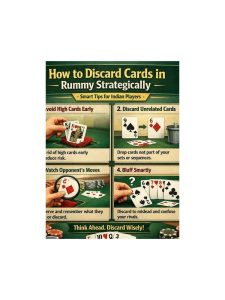
Rummy Tips: Use the Last Discard to Check Your Assumptions
The latest discard is visible evidence, not a complete explanation of another player’s hand. Use it to check your assumptions, then return to your own structure. This prevents one interesting card from taking over the decision.
Ask what the discard suggests and what it does not prove. A card may be unwanted because it did not fit a route, because the player needed space, or because the player had a different priority. Avoid deciding that a single discard reveals a full sequence or a guaranteed safe card.
Now compare the discard with your hand. Does taking it complete a realistic group? Does it remove a high-point liability? Would it expose a route that you prefer to keep private? If the card only creates a theoretical connection, the information it offers may not justify changing your plan.
Also review the card you are giving away. Before discarding, consider whether it clearly helps a common sequence or set. You cannot know another player’s exact hand, but you can avoid making an easy gift when an alternative discard preserves similar value.
Use a short final check: own-hand benefit, information cost, and opponent risk. If the first factor is weak, pass on the visible discard. If it is strong, accept that some information may be revealed and make the choice deliberately.
Good table reading is a process of updating, not storytelling. Let the latest discard adjust your view, but do not let it replace the facts in your own hand or the requirements of the game. Looking at the whole pile can add context, but do not overread it. Several unrelated discards may reflect ordinary hand management rather than a coordinated signal. Use patterns as a soft update and let your own hand remain the primary evidence.
This habit is particularly useful after a surprising draw. Instead of reacting to the surprise, ask which assumption it challenges. Maybe you believed a route was broad, or believed a discard was unavailable. Update that assumption, not your entire strategy, unless the new information truly changes the structure.
If the latest discard does not affect any realistic route in your hand, let it pass without analysis. Not every visible card deserves a theory. Select the information that can change a decision, and preserve attention for your own next draw.
You can also compare the discard with the table’s general rhythm: are players taking visible cards quickly, or mostly drawing privately? Treat that observation as background context, not proof. The strongest update is the one that changes a concrete choice in your hand.