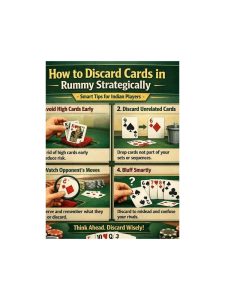
Rummy Tips: Read the Discard Pile in Small Steps
The discard pile contains information, but it does not provide a complete explanation of another player’s hand. A useful reading habit is to collect small, reliable clues instead of inventing a full story from one card. This keeps your decisions grounded and reduces the chance of throwing away a card simply because it seems unlikely to help someone else.
Begin with the most recent visible discard. Ask what practical reason might explain its rejection. A player may have completed a group, changed plans, or simply needed to reduce a high-value card. Each explanation is possible. Treat the discard as evidence of what was not chosen at that moment, not proof of what the player definitely holds.
Then compare the newest card with earlier discards from the same player. Repeated choices can be more informative than a single choice. If someone consistently releases cards from one suit, that may suggest the suit is not central to the current plan. It may also reflect the cards they happened to draw. Keep the observation separate from the conclusion.
Use this information mainly to improve your own discard. Before releasing a card, consider whether it could complete an obvious nearby sequence for an opponent. You cannot protect against every possibility, and avoiding all useful cards would make play rigid. Instead, compare two candidates: one may be valuable to your hand but easy for another player to use, while the other may have similar repair value with less visible risk.
Do not spend so long decoding the pile that your own hand becomes neglected. A good rhythm is observe, compare, choose, and move on. Record only the clearest pattern when reviewing the hand later. Over time, this practice improves attention while preserving uncertainty, which is more realistic than pretending that every discard reveals a definite plan. It also helps to record what you did not know. You may know that a player rejected a seven, but not whether they held a six or eight. Keeping that gap visible prevents a weak clue from becoming a strong assumption. The discard pile is most useful when it supports a modest adjustment to your own plan rather than becoming a puzzle you feel obliged to solve completely. When reviewing, ask whether the clue changed your own action. If it did not, it may have been interesting but not useful. This distinction keeps attention on decisions and avoids collecting observations that never affect play. A small, well-supported adjustment is enough.