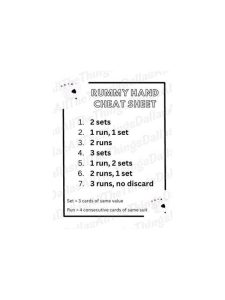
Rummy FAQ: When Should You Split a Near-Meld?

Splitting a near-meld feels uncomfortable because it removes visible progress. Yet a pair or short run is only useful when the cards around it can realistically arrive. Keeping every promising group can leave a hand with too many separate hopes and no reliable route. The decision should be based on opportunity cost rather than attachment.
First, describe the near-meld precisely. A same-suit pair has different prospects from two equal cards that need another copy to form a set. Then list the cards that would improve it and count how many different improvements exist. A pair that can accept cards on two sides offers more room than a pair with one missing end. Do not count a card twice if it is needed by another group in your hand.
Next, compare the near-meld with the structure you would create by splitting it. Perhaps one card becomes part of a flexible sequence while the other joins a strong set possibility. Perhaps breaking the pair releases a high-value card that can be discarded safely. The replacement structure does not need to be complete; it needs to provide a better combination of progress, flexibility, and risk.
Timing matters. Early in a hand, preserving several routes may be worthwhile because more draws remain. Later, a narrow near-meld may need a clear deadline. If its needed cards have not appeared and another route is improving, splitting it can prevent a last-minute scramble. A joker or wild card may also change the calculation, but it should not automatically rescue every weak group.
Before splitting, ask three questions: How many useful cards can improve this group? What does each card do elsewhere? What is my best discard if the group stays? If the answers are vague, keep the group only temporarily and set a review point. A near-meld is a working hypothesis, not a promise. Splitting it is correct when the whole hand becomes more coherent afterward. A useful test is to imagine the next two turns with the near-meld intact and then with it divided. Which version gives you a reasonable discard after an unhelpful draw? The stronger version is usually the one that stays manageable under disappointment, not the one that looks best when the perfect card arrives. Also consider table position and the number of cards remaining in the format. A late split may be necessary when a route has no time left, while an early split can be premature if the group has several improving cards. Keep the decision reversible until the evidence clearly favors one structure.