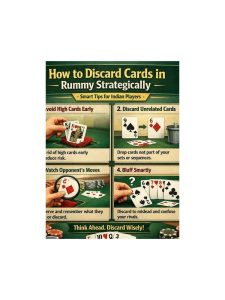
Rummy Tips: Use a Replacement Test Before Discarding
Discarding is not only about what a card does now. It is also about how hard the card would be to recover if a route changes. A quick replacement test can reveal why a seemingly harmless discard may deserve protection, or why a precious-looking card is actually easy to replace.
For each serious discard candidate, ask three questions. What role does the card currently play? Which cards could replace that role? How much of the hand would need to be rearranged to use the replacement? A card supporting two routes has a higher replacement cost than a singleton with several equivalent alternatives.
Do not confuse point value with replacement cost. A high-point card can be easy to replace if it has no meaningful connections. A low-point bridge can be expensive to release if it links two promising sequences. Evaluate the card in the arrangement you have, not by its rank or suit alone.
Consider timing. Early in a hand, replacement cost may be lower because many turns remain and the hand can develop. Late in a hand, even a modestly connected card may be difficult to rebuild. The same discard can therefore be sensible at one stage and poor at another. Reassess after the hand gains or loses a major route.
Also include the information effect. A visible discard may tell another player that a particular route is not yours. That can be useful, neutral, or harmful depending on the table. The replacement test does not predict opponents; it simply reminds you that a discard changes both your own resources and the information available to others.
Use a short comparison: “release now, easy to replace” or “release now, no comparable bridge.” If the second note applies, look for another candidate before committing. A replacement test takes only a moment and protects the hand from decisions that feel cheap because their future cost is hidden.
The test is particularly valuable for bridge cards. Bridges often look ordinary because they do not complete a group yet, but they may connect several useful arrangements. If another card performs the same connecting job with less cost, release the weaker bridge. If no substitute exists, keep it only with a defined review point so its special value remains accountable. The same idea applies to a card that appears safe because it is low value. If it is the only connector between useful groups, its replacement cost may be high despite its small penalty. Test both structure and points before deciding that a card is cheap to release.