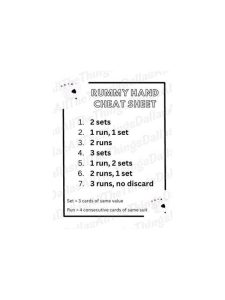
Rummy Comparison: One Strong Run Versus Two Developing Sets
A nearly complete run feels reassuring because its missing card is easy to name. Two developing sets can offer more than one route, but they may also require several specific ranks. The better choice depends on flexibility, rule requirements, and the penalty of being wrong.
Start by checking whether the strong run contributes to a required pure sequence. If it does, its value is higher than its visual neatness suggests. A run that cannot satisfy that requirement may still be useful, but it should compete honestly with the developing sets rather than receive automatic priority.
Then count completion routes. One run needing a single card has a clear dependency. Two sets may have two or three possible completions, yet each completion could be scarce or could leave a high card stranded. Write down the exact cards needed and look for overlaps. A plan requiring three different cards is not automatically better than one requiring one; the timing and availability matter.
Consider discard flexibility as well. A strong run may lock several cards together, leaving an awkward card elsewhere. Developing sets can let you release a pair while preserving another option. On the other hand, keeping too many half-sets can fill the hand with uncertain cards and slow the move toward a valid structure.
Use a simple test: which plan improves the hand if the next draw misses? A resilient plan still leaves a reasonable discard and at least one live route. A brittle plan creates a stranded group and forces a costly release. Choose the route with the better missed-draw position, not merely the route with the most exciting possible completion. Finally, compare routes under the actual scoring environment. In a format where one incomplete high card is costly, a plan that reduces exposed points may be attractive even when it develops more slowly. Where a required sequence is decisive, that requirement dominates. Write the deciding condition before the next turn so the choice remains tied to the rules rather than to the appearance of the cards. Do not confuse a neat-looking hand with a finished hand. A run can be visually strong while failing a format requirement, and two sets can look messy while leaving a valuable sequence available. Check legality first, then compare completion and fallback. Structure is valuable only when it serves the rules you are playing. If the comparison remains close, prefer the route that is easier to abandon without a severe penalty. Flexibility has practical value because future draws are uncertain. The best plan is often the one that gives you a good improvement now and a manageable hand after an ordinary miss.