Rummy Guide: Use the Discard Pile as a Timing Record

Keep the record selective. Note only events that could change your route, such as a key connector appearing, a high card being released late, or a player repeatedly taking from the pile. Selective attention leaves more space for your own hand and prevents ordinary discards becoming elaborate stories. Timing is most useful when it changes an action. If a clue does not affect your discard, route, or level of caution, let it go. This keeps observation from becoming a distraction and preserves attention for the decisions you can actually control.
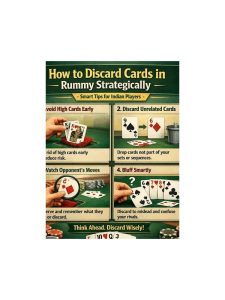
The discard pile provides more than a list of unavailable cards. Its order can show how a hand is changing. Treating it as a timing record helps you avoid reading a single discard as a complete signal and encourages decisions based on repeated evidence.
Begin with the most recent cards. A player who repeatedly ignores a suit may be less interested in that route, but one discarded card proves very little. A card may have been released because the player completed a different plan, needed to lower points, or simply had no alternative. Look for patterns across several turns before assigning meaning.
Record three observations: the card released, the position in the turn sequence, and what changed immediately afterward. If a player takes a card and then discards a neighboring rank, that may reveal a shift in their hand, but it does not reveal their entire arrangement. Your goal is to estimate which cards are safer to discard, not to construct an imaginary perfect picture of another hand.
Timing can also help you manage your own plans. If a useful-looking card has remained available for several turns, ask why it has not been taken. Perhaps it is not useful, or perhaps the visible route is a trap for your assumptions. If the card disappears just before you need it, return to your backup route instead of forcing a replacement that increases risk.
Use a confidence scale. Mark a reading as weak after one clue, moderate after two related clues, and stronger only after a consistent pattern. This prevents overconfidence and keeps the discard pile in its proper role: evidence, not certainty. The same discipline applies when a player takes from the pile, because taking a card can be a deliberate signal or a practical necessity.
After the round, check which observations were accurate. Keep the useful timing habits and discard the stories that were not supported. The pile cannot remove uncertainty, but it can make your response to uncertainty more measured.